
I was sitting across from Lyra (a fictitious name, to protect her identity), listening as she calmly dissected my work and career choices. It was a coffee chat I had gladly accepted, even though I felt unprepared; I was in the middle of many things, as usual. Typical Charity. Lyra had already exited her first company, selling it for what she casually described as “a few cool millions”, and was now building something new something more ambitious, more exciting. As she spoke about her journey, the pivots, and the conviction behind her decisions, I realized something unsettling: I couldn’t focus.
Not because her story wasn’t impressive but because it wasn’t unfamiliar. I had heard versions of this story before. I had heard the confidence, the clarity, and the certainty. And yet, something about her felt different. So I finally asked the question that had been burning quietly in my chest: Is it grace? Is it luck? What are you doing differently? She paused, looked at me, and said simply: “Details, Charity.”
At first, I didn’t understand. Details? I asked her to go deeper, and she did. Every small decision, every process, every assumption from beginning to end had been intentionally planned. Nothing was accidental. Nothing was left vague. I was in awe as she walked me through her thinking. I had heard one Professor say something similar in a lecture once. I had watched the YouTube clips. But this was different. This was a front-row seat to what obsession with detail actually looks like in practice. That conversation stayed with me.
It was the same thing I began to notice when I arrived at Wharton and even earlier at HEC Paris. But since I was now fully immersed at Wharton, let me let you into this world for a moment. The level of precision here is almost startling. The questions we are trained to ask. The rigor expected in answers. The insistence on clarity. It confirmed something I already knew deep down: excellence is built by sweating the smallest things. Implementation, down to the very last minute. From coffee chats to lectures, workshops, and conferences, I kept hearing Lyra’s voice echo in my head: ‘Details, Charity. It became all I noticed. All I experienced. And eventually, all I wanted to carry forward as a marker of excellence in my life after my MBA.
During my first quarter, I leaned heavily into the technicals. Courses like Entrepreneurship Through Acquisition (ETA) and AI, Business, and Society forced me into depth, not surface-level familiarity, but real understanding. I learned what it actually takes to acquire a business. I went deep into artificial intelligence beyond headlines, understanding how AI agents are built, how large language models function, and what happens in the backend that most people never see. In the second quarter, I moved fully into strategy: marketing strategy, retail strategy, competitive strategy, corporate governance, product management, and AI strategy. Just like the first, it was intense and comprehensive, ending with major final papers that demanded coherence, discipline, and synthesis.
Again, the same lesson revealed itself: agency and excellence are created in the details.
Somewhere in the middle of all this, I ran into Blessing. I asked her what it truly meant to be part of the Wharton community. She mentioned the upcoming Wharton Africa Business Conference and asked if I’d considered contributing. I applied to the board, and soon after, I joined the Marketing & Communications team. That decision became one of the highlights of my MBA experience.
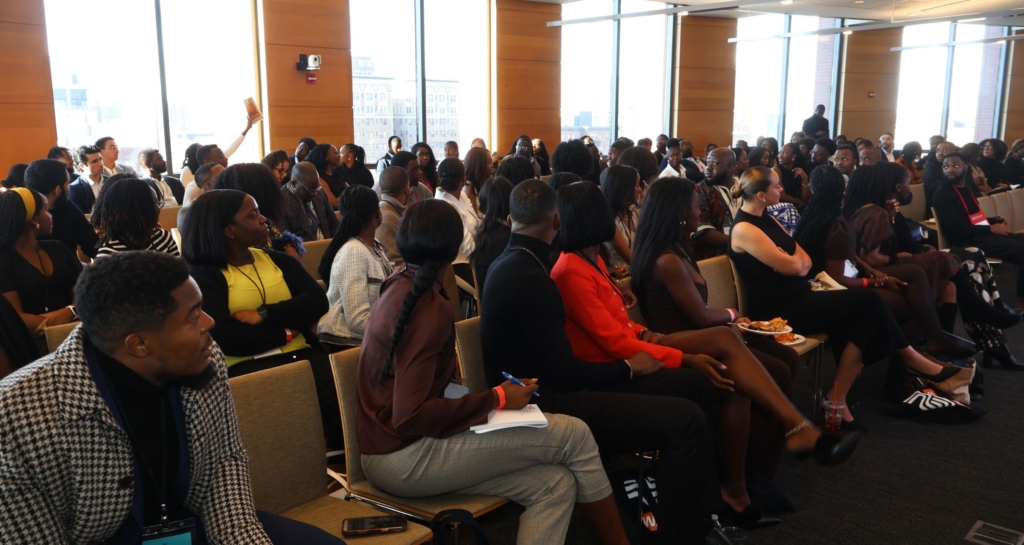
I had the privilege of working with some of the most brilliant people I’ve encountered to plan the 32nd Wharton Africa Business Conference, held in November at Huntsman Hall. Together, we coordinated a conference that brought together over 60 global speakers and more than 500 attendees. I led digital communications on LinkedIn and managed the conference website, ensuring coherence, clarity, and credibility across platforms.
From keynotes to panels, fireside chats to informal conversations, the experience was electric. It was a masterclass in what it means to convene ideas, people, and purpose at scale. As nations emerging and developed alike struggle to navigate an increasingly complex global order, it has become clear to me that between strategy and outcomes lies something often overlooked: policy. Policy gives structure. It signals intent. Most importantly, it provides direction.
I knew the policy conversation at the conference mattered deeply. The audience was brilliant and hungry for answers. I was hungry too, especially for my own country, Ghana. When I learned that the original moderator, a Wharton professor, could no longer attend and I was asked to step in, I understood the weight of what was being entrusted to me. This panel was no small feat.
The speakers were global policy and international leaders individuals who had spent decades shaping, negotiating, and implementing decisions at the highest levels. There was only one thing to do: prepare relentlessly. I read their profiles repeatedly. I followed the news. I watched interviews and past talks. I reached out to mentors and trusted voices, one of whom became a coach through the process. Together, we worked through framing, pacing, and depth.
What followed was a personal masterclass in what it means to moderate with responsibility. The need to assert agency for individuals, institutions, and nations is one of the defining conversations of our time. No country exists in isolation, yet every country deserves a voice in decisions that shape its future. These conversations matter. And they must be held with rigor, respect, and obsession with the details.
Because in the end, that is how excellence and agency are built.